Frequently Asked Questions
Everything you need to know about ONOXIA.
What is ONOXIA?
+
−
ONOXIA is an AI-powered chat widget that you can embed on any website with a single script tag. It uses Retrieval-Augmented Generation (RAG) to answer visitor questions based on your own documents, FAQs, and texts. Powered by European AI — Mistral AI (Paris) and OVHcloud (Roubaix), both in France. ONOXIA is a product of OCENOX LTD, a New Zealand-based software company specializing in the DACH market.
How does the RAG knowledge base work?
+
−
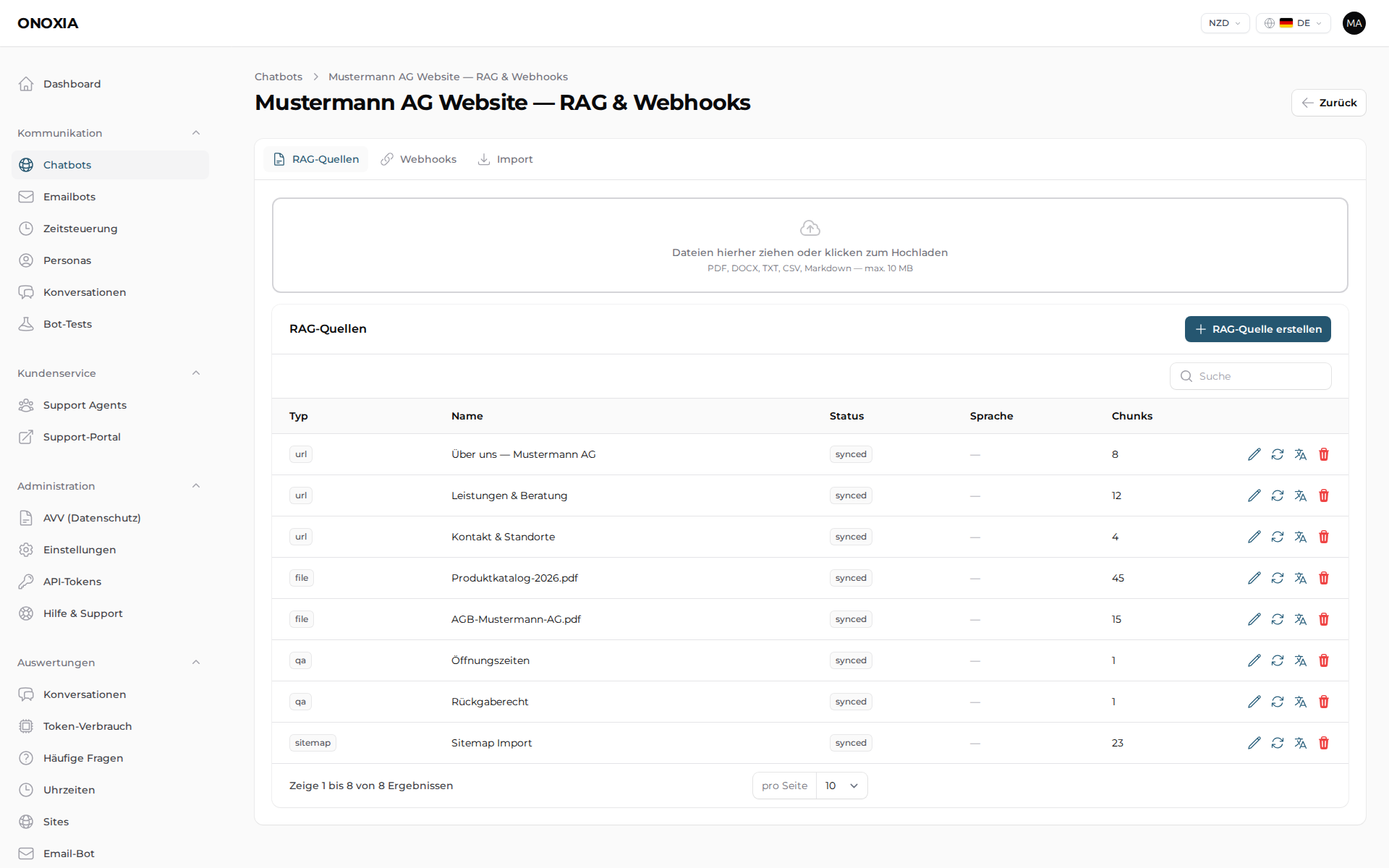
RAG stands for Retrieval-Augmented Generation. You upload your documents (PDFs, texts, FAQ pairs) in the ONOXIA Dashboard. The system automatically splits the content into chunks, creates vector embeddings, and stores them in a knowledge database. When a visitor asks a question, ONOXIA first searches your knowledge base for relevant passages and then generates a precise answer based on your own content — no hallucinations, just well-founded answers from your knowledge.
Is ONOXIA GDPR compliant?
+
−
Yes. ONOXIA was built from the ground up for the European market. Specifically: No cookies — the widget sets no cookies and only uses the browser's sessionStorage for the current chat. IP addresses are hashed with SHA-256 and never stored in plain text. The optional consent dialog is fully configurable. Our servers are located in Finland (EU). By default, AI processing is carried out by Mistral AI and OVHcloud in France (EU); the providers neither retain chat data nor use it to train AI models. Non-European models (e.g. Qwen or Gemini via OpenRouter) are only used if you explicitly select them — and then only via endpoints without data retention, under EU Standard Contractual Clauses. A data processing agreement (DPA) is included.
What are "tokens" and how many do I need?
+
−
Tokens are processing units for AI text generation. One token equals approximately 4 characters or 0.75 words. A typical chat message (question + answer) uses about 200-500 tokens. The Free plan (50,000 tokens/month, monthly reset) allows approximately 100-250 messages per month — free forever.
How many messages can I send with my tokens?
+
−
It depends on conversation length. A single message (question + answer) typically uses 300–600 tokens. Rules of thumb: Free (50,000 tokens/month) ≈ 100–250 messages or 25–50 full conversations with follow-ups. Professional (500,000) ≈ 1,000–2,500 messages. Enterprise (2,000,000) ≈ 4,000–10,000 messages. Track your usage in the dashboard. Token packages can be purchased as one-time add-ons and never expire.
Which AI does ONOXIA use — and why not OpenAI?
+
−
By default, ONOXIA uses European AI providers: Mistral AI (Paris) and OVHcloud (Roubaix), both in France — including the embeddings for your knowledge base. For customers who value GDPR compliance, this is crucial: chat data is processed in the EU, is not retained by the providers and is not used for training. No data is sent to OpenAI. The models perform excellently in German and English. Non-European models can be selected per bot if needed, but are never the default.
What is Shadow DOM and why does it matter?
+
−
Shadow DOM is a browser technology that completely isolates the ONOXIA widget from your website. Your CSS styles don't affect the widget and vice versa. No JavaScript conflicts. The widget is guaranteed to work on any website. Other providers like Tidio, Chatbase, or Boei don't use Shadow DOM — CSS conflicts can occur there.
How do I integrate ONOXIA on my website?
+
−
Copy the script tag from your ONOXIA Dashboard and paste it before the closing </body> tag of your website. One single HTML tag — no NPM packages, no build steps, no dependencies. The widget loads asynchronously and works immediately.
Can the bot perform actions (webhooks, Calendly)?
+
−
Yes. Starting with the Professional plan, the bot can communicate with your systems via webhooks — capture leads, create support tickets, send emails. The Calendly integration enables appointment booking directly in the chat.
What can webhooks do and how do I set them up?
+
−
Webhooks enable the bot to communicate with your existing systems automatically. In the dashboard, you define custom bot tools per site: tool name, description, and target URL. The bot intelligently decides when to use a tool during conversations. Each webhook call is signed with HMAC-SHA256 for authenticity verification. Automatic retry with exponential backoff. Available from the Professional plan.
How does the Calendly integration work?
+
−
From the Professional plan, you can activate Calendly integration. Enter your Calendly API key, event type URL, and trigger keywords in the dashboard. The bot detects appointment requests, checks available slots, and books directly in the chat — without the visitor leaving the page.
What is Live Chat / Human Handover?
+
−
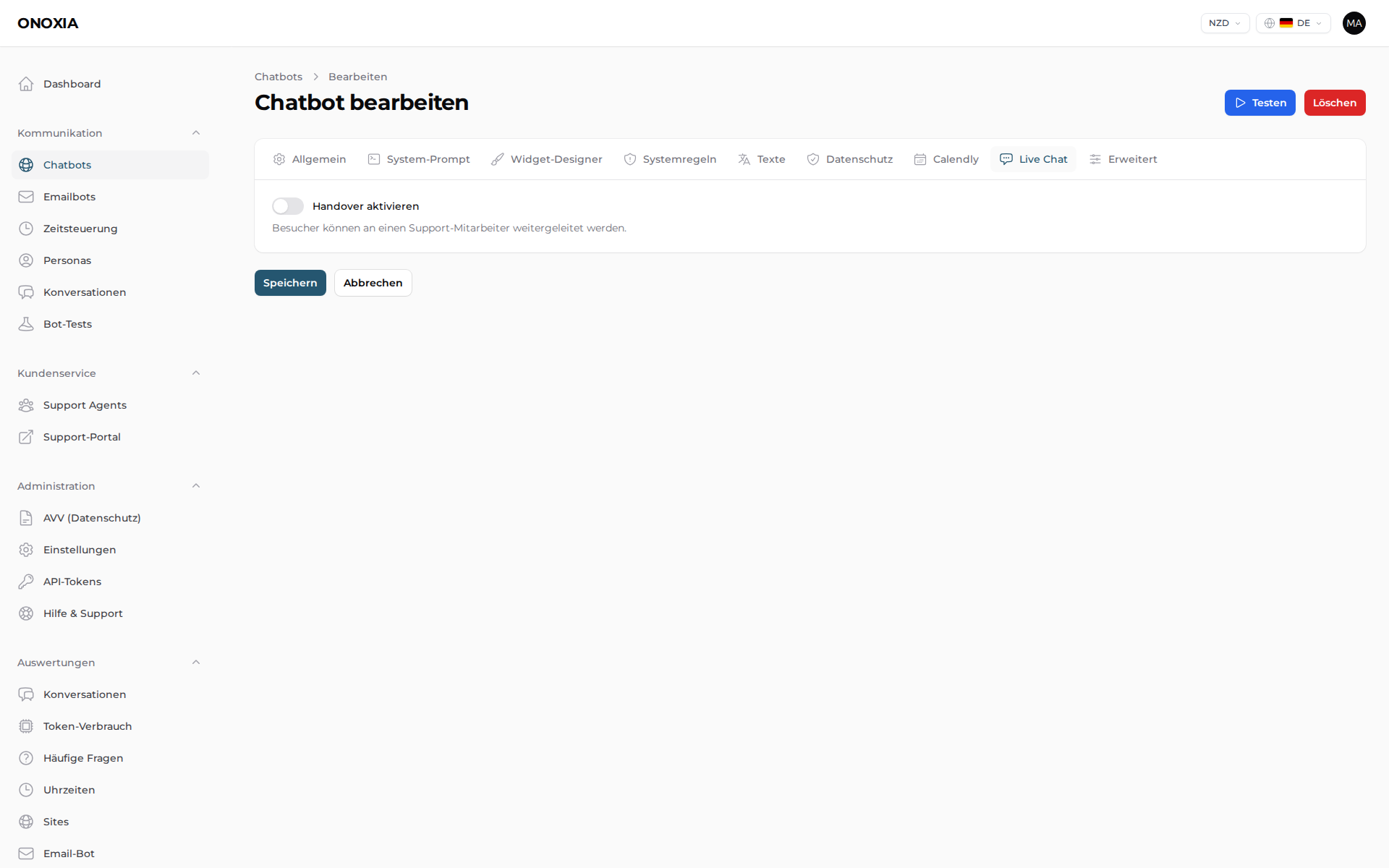
Enterprise feature: Support agents can take over bot conversations and chat directly with visitors through a dedicated portal (onoxia.nz/support). Create agents in the dashboard and assign them to sites. Handover can be triggered by visitors or by the bot itself. Configurable timeout (default: 5 minutes) — if no agent takes over, the conversation automatically returns to the bot.
How can I customize the widget design for my brand?
+
−
The widget designer offers 9 configurable colors, position (right/left), trigger size (50-80px), and custom avatar upload. Greeting texts and placeholders are configurable per language. Personas allow individual bot identities with custom name, avatar, and system prompt. Variables like {site_name}, {language}, {date} are available.
Does ONOXIA support voice input?
+
−
Yes. ONOXIA is the only chat widget provider with built-in voice input. Visitors click the microphone icon and speak their question. The recording is transcribed via speech-to-text and can be edited before sending. Especially useful on mobile devices and for accessibility.
How is ONOXIA protected against spam and abuse?
+
−
Multi-level protection without CAPTCHA: Rate limiting (20 req/min, 100/hour, 50 msg/conversation, 2,000 chars/message), invisible honeypot field, input sanitization, CORS whitelisting, HTML stripping. The token budget provides additional protection against excessive usage.
Can I run multiple websites with one account?
+
−
Yes. Free: 1 site, Professional: 3 sites, Enterprise: 10 sites. Each site has its own widget design, RAG knowledge base, system prompt, webhooks, and persona. The token budget is shared across all sites.
What payment methods are accepted?
+
−
It depends on your country. EU, Switzerland and the UK (EUR): credit card incl. Apple Pay and Google Pay via Stripe, SEPA Direct Debit via GoCardless, or bank transfer to our EU account (IBAN); all EUR invoices are ZUGFeRD/Factur-X e-invoices. New Zealand and Australia (NZD): credit card via Stripe or bank transfer to our NZ account. All other countries (USD and 30 local currencies): payment via Paddle as Merchant of Record — credit card, PayPal, Apple Pay, Google Pay and local payment methods; Paddle also handles sales tax. Billing is monthly or yearly in advance.
Who is behind ONOXIA?
+
−
ONOXIA is a product of OCENOX LTD, a software company based in Auckland, New Zealand. OCENOX was founded by René Hoyer, an IT consultant with over 23 years of experience and certifications in SAFe, Scrum, ITIL, and REQB. The name OCENOX combines "Oceania" and "Nox" (Latin for night) — a nod to using timezone differences between New Zealand and Europe as an advantage. OCENOX specializes in the DACH market and combines European expertise with New Zealand agility. Besides ONOXIA, OCENOX also develops NoxSphere ONE, an ERP system from which the ONOXIA AI technology originally stems. Learn more at
ocenox.com.
How is ONOXIA different from Intercom Fin?
+
−
Intercom Fin is a powerful AI agent on top of the Intercom platform — but it requires the full Intercom suite and is priced per resolution (typically US$0.99 per AI answer) on top of seat fees. ONOXIA is a standalone widget without per-message fees: you pay a flat monthly token budget (50k to 2M tokens depending on plan) and use it across multiple sites. By default, ONOXIA processes data in the EU (Mistral AI and OVHcloud in France, servers in Finland) for GDPR-strict customers, while Intercom is a US company subject to US data law. ONOXIA starts free forever (50,000 tokens/month) — Intercom's base plan starts at US$39 per seat per month plus Fin resolutions.
How is ONOXIA different from Tidio?
+
−
Tidio is a Polish live-chat platform with an optional AI add-on (Lyro). ONOXIA is RAG-first: every answer is grounded in your own documents, while Tidio Lyro primarily relies on a smaller built-in dataset and FAQ entries. ONOXIA uses Shadow DOM isolation so it never conflicts with your site's CSS — Tidio injects styles into your global DOM. ONOXIA supports 28 bot languages with native voice input out of the box; Tidio Lyro currently supports fewer languages. ONOXIA is made by a New Zealand company but runs on European infrastructure by default — servers in Finland and AI inference by Mistral AI and OVHcloud in France.
How is ONOXIA different from Chatbase?
+
−
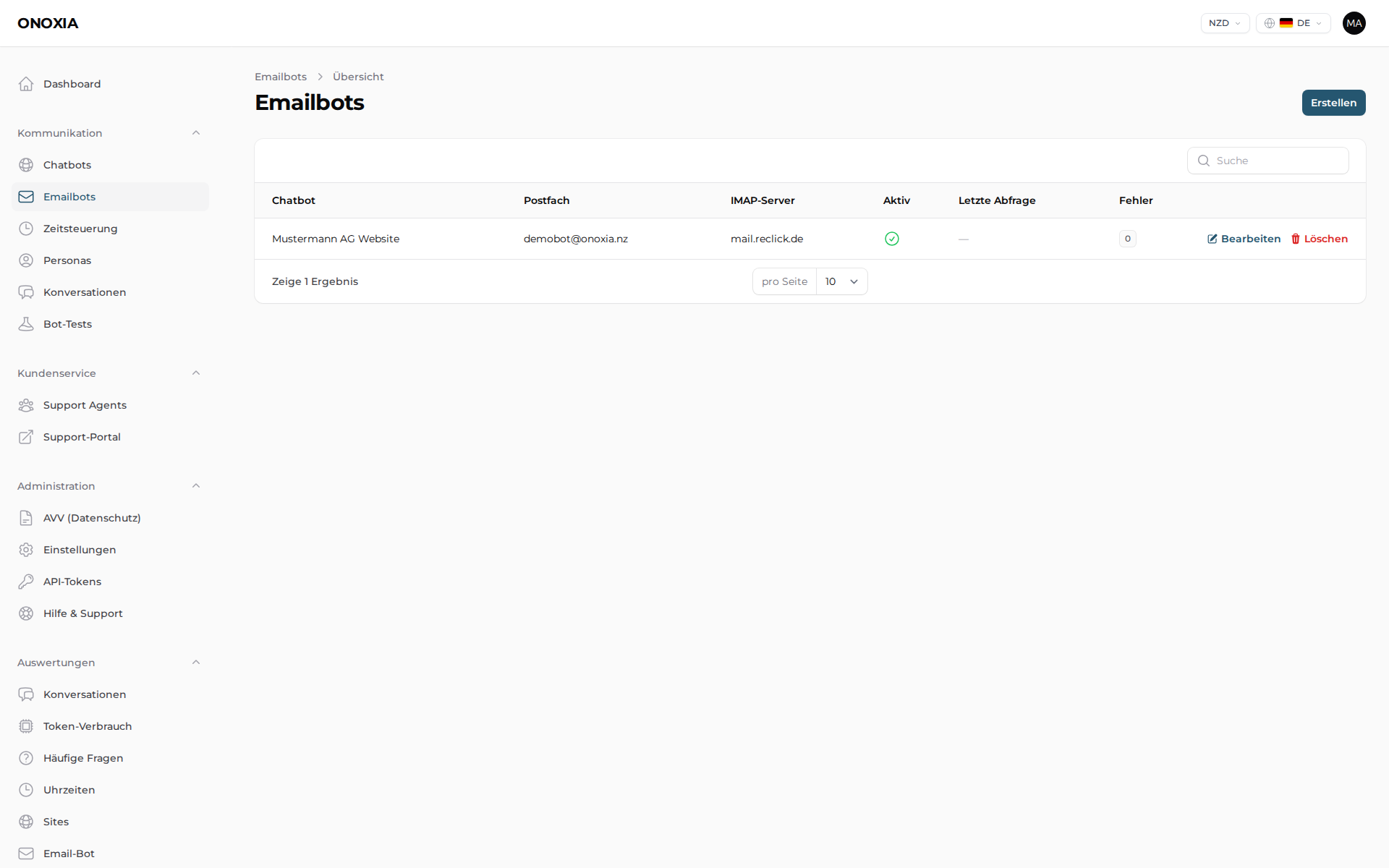
Chatbase is a US-based RAG chatbot builder using OpenAI under the hood — all chat data passes through OpenAI's US infrastructure. ONOXIA is fundamentally EU-first: by default, inference runs on European AI (Mistral AI and OVHcloud, France), with no data sent to OpenAI. ONOXIA also includes features Chatbase does not ship by default: voice input, Calendly integration, live human handover, IMAP/SMTP email agent, and 28 bot languages with automatic language detection. Chatbase is meta-pages oriented; ONOXIA is widget-first with Shadow DOM, multi-site support and a dedicated widget designer. Pricing is comparable, but ONOXIA includes GDPR-compliant data residency without an enterprise upgrade.
Is ONOXIA a Drift alternative?
+
−
Yes — for businesses that want Drift's conversational marketing capabilities without enterprise-tier pricing or US data residency. ONOXIA covers the core Drift use cases (visitor engagement, lead capture, calendar booking, routing to a human) at a fraction of the cost: a free-forever entry plan (50,000 tokens/month) versus Drift's enterprise-only contracts. ONOXIA's RAG knowledge base also lets the bot answer product and pricing questions directly from your PDFs and docs, which Drift treats as a separate content layer. If you need ABM-grade account scoring and Salesforce-deep integration, Drift is still ahead — but for most SMBs ONOXIA is the more pragmatic fit.
Can I try ONOXIA without a credit card?
+
−
Yes. The Free plan is free forever (50,000 tokens per month) — no credit card, no subscription. Paid plans (Professional, Enterprise) can be tested for 14 days with their full feature set and 50% of the token budget: register at onoxia.nz/app/register, create your first site, add your knowledge (PDFs, FAQs, URLs or your whole website), embed the widget and test. With invoice billing (EU and New Zealand) no credit card is needed: you receive the invoice right away — the trial appears as a €0 line, the first month is only due when the trial ends — and you can cancel at any time with one click; the invoice is then cancelled. With Paddle (all other countries) you enter a payment method at checkout; nothing is charged during the trial, the first payment is taken automatically after 14 days unless you cancel beforehand. If an invoice is still unpaid after the trial, there is a 14-day grace period; after that the bot is paused. Data of paused accounts is deleted no earlier than 90 days after the pause, following 14 days' advance notice.
Does ONOXIA work on WordPress, Joomla, and Shopify?
+
−
Yes — ONOXIA embeds via a single <script> tag and is compatible with any CMS or static site. Official plugins are available for WordPress and Joomla (one-click install with dashboard settings). For Shopify, Wix, Squarespace, Webflow and plain HTML, you paste the script tag into the site footer or theme settings. The widget is loaded asynchronously (~30 KB, vanilla JavaScript, no NPM dependencies) and runs inside a Shadow DOM, so it never inherits or conflicts with your theme's CSS. CDN delivery from cdn.onoxia.nz keeps load impact below 50 ms on typical connections.